Opening a Café? Read This Before You Buy a Machine
I repair espresso machines for cafés across Minnesota. Most of the problems I’m called for were decided before opening day. Here’s what I’d tell you if you called me first.
Scale is the number one thing that kills espresso machines early, and Twin Cities water is hard. Scale builds up inside the boiler and the small brass jets that meter water to each group, and once they choke, shots run slow and uneven no matter how good your barista is.
Most manufacturers require water treatment to keep the warranty. One of the brands I sell voids it outright if hardness is over 80 parts per million. So test your water first, then size a filter or softener to it.
The trap I see most: the under-sink filter feeds the sink, not the espresso machine. The machine needs its own treated line.
Most two- and three-group machines run on 208–240V and need their own circuit. A few one-group and compact models run on 120V, which is why they make sense for a counter inside another business.
Send your electrician the machine’s spec sheet before the walls close up. The circuit, the breaker and the plug (often a twist-lock like an L6-30) all have to match it. Install day is the worst day to find out the outlet is wrong.
Size the machine to how many drinks you’ll pull in your busiest hour. One group is fine for a small menu or a bar inside another business. Two groups is where most cafés land. Three groups is for real volume, or a showpiece.
Volumetric machines (buttons that stop the shot for you) keep shots consistent when staff changes. Whatever you pick, ask one question before the brand name: who can get parts for it in Minnesota, and how fast? A beautiful machine with no local parts is a machine that sits.
My specific picks are in the next section.
04The machines I’d actually recommend
Here’s what I’d tell a friend, by the kind of café you’re opening. I pick these as the person who’ll be fixing them later: parts I can get fast, designs I know inside out, and enough capacity that the machine isn’t the bottleneck. Tap any machine for photos, options and price.
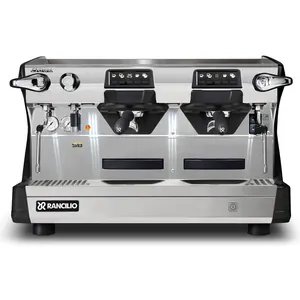
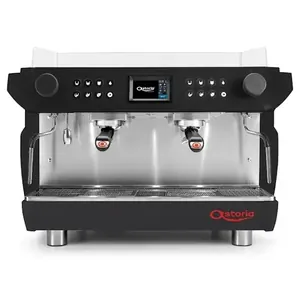
Why I’d pick it: My default recommendation. The Tall version clears 5.7 inch cups, so most to-go cups go straight under the spouts. Simple heat-exchanger design, buttons that stop the shot for your barista, and the parts are on every distributor’s shelf, so a repair is a day, not a month.
Watch for: Decide on Tall before you order: it’s a different version of the machine, not an add-on. A compact 24 inch version also comes in 120V if you can’t get 240V.
A coffee bar inside another business, or a counter with no 240V
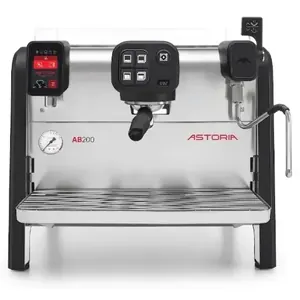
Why I’d pick it: A real commercial machine that runs on a regular 120V outlet, with programmable doses and a tall-cup tray. It suits a bakery, gym, church or office bar doing a few dozen drinks a day.
Watch for: One group means one shot at a time. If you expect a morning line, step up to a two-group.
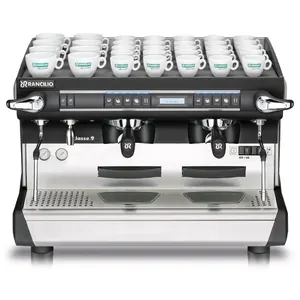
Why I’d pick it: Same 11 liter boiler as a full-size Classe 5, but 6,000 W of heating instead of 4,300 W, so it recovers faster when two baristas are pulling shots and steaming milk nonstop. It also adds a display for programming every group. Same Rancilio parts family as the Classe 5. Pair it with 83 mm burrs so the grinder keeps up.
Watch for: It costs thousands more than a Classe 5 Tall. If you’re not running a real line for hours a day, the Classe 5 Tall is the better buy. It also needs its own 30A circuit.
Why I’d pick it: A separate brew boiler for every group, so you can run a different temperature for each coffee. If your menu changes roasts often, this is the machine that rewards it.
Watch for: More boilers means more to descale. Good water treatment isn’t optional on this one.
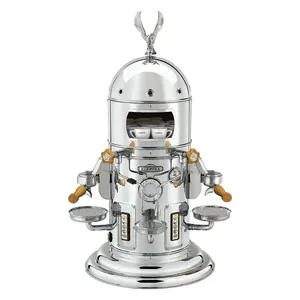
Why I’d pick it: The eagle-topped machine people photograph before they order. If the machine is part of your brand, nothing else gets that reaction.
Watch for: It’s built for looks first. Plan a lower-volume menu or a second machine for the rush.
05Don’t cheap out on the grinder
The grinder decides how your espresso tastes as much as the machine does, and it’s where new owners most often save money they regret. Get an on-demand espresso grinder matched to your volume. If you’ll offer decaf or a guest roast, plan on a second grinder from the start.
06Plumbing and the drain
The machine needs a water line with its own shutoff valve and a drain it can reach. Check what your health inspector wants for the drain before you build the counter.
One detail that stalls installs: Italian machines use BSP fittings, US plumbing uses NPT. They look alike and they don’t seal together. Have the right adapters on hand.
07Leave the machine room to breathe
Machines dump heat. Every manual lists the clearance it needs on the sides and back, and tucking it into a tight cabinet or against a wall cooks the electronics and trips the safety thermostat.
Mostly the small stuff, and it’s preventable. Group gaskets and shower screens clog with coffee oil, and if nobody backflushes daily, shots start tasting bitter within weeks. Train every barista on the daily and weekly cleaning, not just the person who opens.
A maintenance plan costs less than one bad Saturday with the machine down. I check gaskets, screens, pressures, temperatures and water on a schedule so problems get caught small.
Machine, grinder, water treatment, delivery, install and training, from the same person you’ll call for service for years after. You’ll also get the equipment spec sheets your contractor and health department plan review need.
Three ways to build it
Pick a Starting Point
Every café is different, so every package is quoted to your space. These are the usual starting points.
Starter Bar
Lean & Ready
A tight menu, a small counter, or a coffee bar inside another business.
1–2 group machine (120V options for counters without 240V)
Every package can be set up as lease-to-own. Spread the cost of the machine into monthly payments and own it at the end — so your cash goes into opening, not into one big equipment bill. Same delivery, installation, training and service as buying outright.
A full café bar, a single machine, a grinder or lease-to-own — tell me what you’re planning and you’ll get one written number with delivery and installation priced in.
I reach out personally — usually by text, the same day.
We talk through your setup — menu, volume, counter space, power and water.
You get a written quote — everything spelled out, no surprises.